
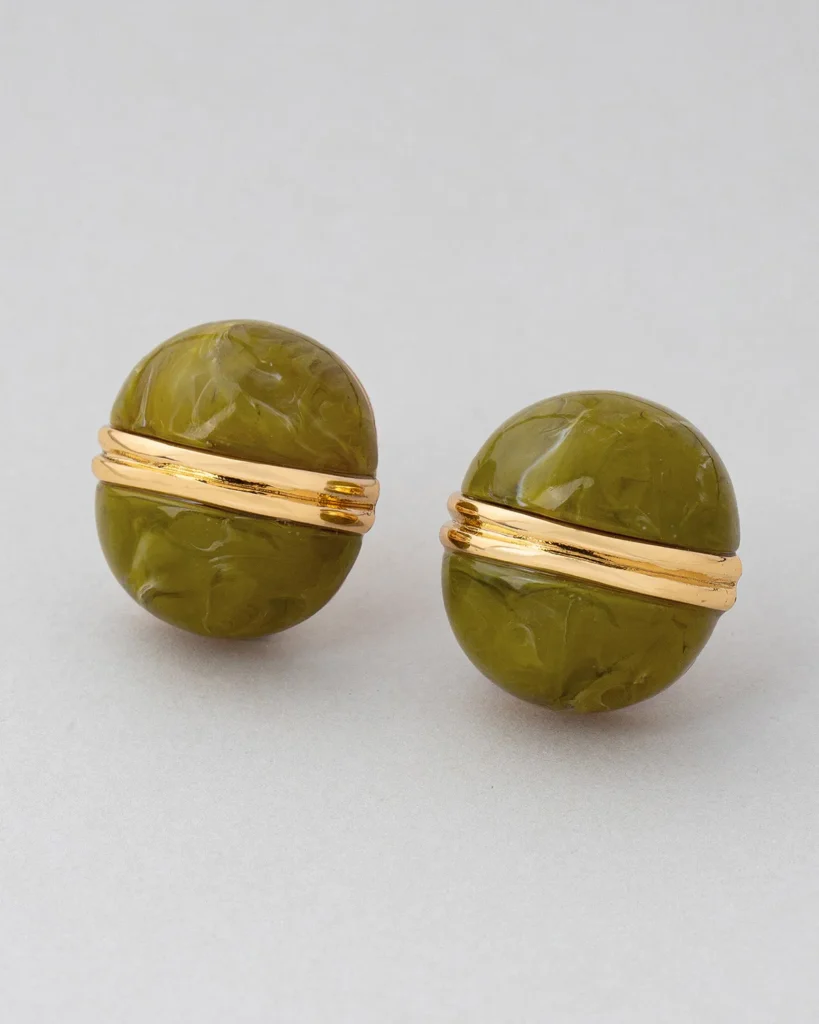
For boutique brands, statement resin earrings need to balance visual impact with practical wearability and reliable production. The right wholesale selection is not simply the largest design available. Buyers should evaluate overall dimensions, resin thickness, finished weight, hardware, surface quality, color consistency, and how easily the design can be reproduced across a collection.
Why Size and Weight Matter in Statement Earrings
Statement earrings are designed to attract attention through larger silhouettes, bold colors, unusual shapes, or layered construction. Resin gives manufacturers flexibility to create these visual effects while keeping designs more adaptable than many solid-metal alternatives.
However, increasing the size of a resin component can also increase its material volume and affect the finished weight. Two earrings with similar height and width can feel very different depending on their thickness, shape, construction, and hardware.
For boutique buyers, the objective should be to specify the visual size and then evaluate the physical sample before committing to wholesale production.
Start With Overall Dimensions
When requesting statement earrings from a manufacturer, avoid specifications such as simply “large” or “oversized.”
Instead, define measurable dimensions:
- Overall length
- Maximum width
- Resin component thickness
- Drop length, where applicable
- Hardware dimensions
- Approximate finished weight
These measurements give the manufacturer a clearer production target.
Current wholesale examples show why dimensions alone are not enough. Market listings for resin statement earrings range from relatively compact designs to pieces measuring several inches, with some suppliers specifically emphasizing lightweight construction despite a large silhouette.
For a boutique collection, compare the physical proportions of the sample rather than assuming that a larger measurement automatically creates a better statement piece.
Weight Should Be Evaluated With the Design
Weight is one of the most useful specifications to record during sampling.
A large earring can still be designed around a relatively lightweight resin component, but the final weight depends on more than the resin itself. Thickness, embedded elements, metal hardware, layered construction, and overall geometry all contribute.
Some current wholesale resin statement earrings are explicitly marketed around lightweight construction, demonstrating that visual scale and finished weight can be treated as separate design considerations.
For B2B buyers, the useful question is not simply “How light can you make it?” Instead, ask whether the proposed weight is appropriate for the intended silhouette and construction.
During sampling, record the finished weight of the complete earring—not only the resin component.
Resin Thickness Changes the Finished Product
Thickness has a direct effect on both appearance and material usage.
A thin resin component may create a flatter, lighter visual effect, while a thicker component can produce a more substantial sculptural appearance. But increasing thickness without reviewing the complete construction can make an otherwise attractive design unnecessarily heavy.
This is why size, thickness, and weight should be developed together.
For custom designs, provide the manufacturer with the intended dimensions and reference images, then use the physical sample to determine whether the proportions need adjustment.
Choose the Resin Effect for the Collection
Resin offers several ways to create statement effects without relying solely on size.
Haishaer Jewelry’s manufacturing capabilities include custom resin colors, transparent and translucent effects, embedded designs, and resin textures. These options can help boutique brands build different visual directions around a consistent product category.
For example:
Solid resin colors work well when the collection depends on strong color coordination.
Transparent or translucent resin can introduce visual depth and make a large component appear less visually dense.
Embedded designs allow decorative details to become part of the resin structure.
Textured resin adds surface interest and can support a more sculptural aesthetic.
The key sourcing decision is to determine which effect supports the collection concept before requesting samples. Too many decorative treatments in one design can make production more complicated without necessarily improving the finished product.
Hardware Should Be Included in the Sampling Process
A statement earring is not just a resin component.
Posts, hooks, connectors, frames, and other metal components affect both appearance and construction. Copper and zinc alloy components can be used in resin jewelry, depending on the design requirements.
Pay attention to the relationship between the hardware and the resin shape. A delicate metal component paired with a very large resin form may create a different visual balance from a heavier frame or connector.
The attachment point is also worth checking during sampling. It should align with the intended position of the earring and remain visually consistent across the production batch.
How Boutique Buyers Should Compare Wholesale Options
When comparing several statement resin earring styles, create a simple product specification sheet.
| Factor | What to Check |
| Overall size | Length, width, and drop |
| Resin thickness | Consistency and visual proportion |
| Finished weight | Weight of the complete earring |
| Shape | Symmetry and repeatability |
| Color | Match against approved reference |
| Surface | Smoothness, texture, scratches, and polishing |
| Hardware | Material, finish, attachment, and alignment |
| Customization | Color, shape, resin effect, and branding |
| Packaging | Cards, boxes, labels, and private label requirements |
This makes supplier comparisons more objective and reduces the risk of selecting a design based only on product photographs.
Sampling Before a Wholesale Order
For boutique brands developing private label collections, sampling should be treated as a production checkpoint.
The physical sample allows buyers to evaluate details that digital artwork cannot fully communicate:
- Actual scale
- Finished weight
- Resin thickness
- Color appearance
- Transparency
- Surface finish
- Hardware proportion
- Attachment position
- Overall balance
If the sample feels too heavy, the solution may not simply be to make the entire design smaller. The manufacturer may be able to review the resin thickness, shape, construction, or component arrangement instead.
The important point is to make these decisions before bulk production.
MOQ Depends on the Product Specification
Wholesale buyers should avoid evaluating MOQ without explaining the complete project.
A standard design, a customized color version, and a completely new OEM design can involve different manufacturing requirements. Custom molds, resin color development, special effects, hardware changes, and private label packaging can all affect how a project is handled.
When requesting a quotation, provide:
- Number of designs
- Estimated quantity per design
- Required colors
- Custom dimensions
- Resin effects
- Hardware requirements
- Packaging requirements
- Target collection timing
This gives the manufacturer enough information to discuss the project accurately instead of providing a generic MOQ that may not apply to the final design.
Quality Control for Statement Resin Earrings
Large earrings make surface and dimensional inconsistencies easier to see.
A wholesale inspection should cover both the resin component and finished assembly.
Check the resin for:
- Color consistency
- Shape consistency
- Surface scratches
- Cracks or visible defects
- Uneven polishing
- Transparency or translucency consistency
- Embedded design placement
- Texture consistency
Then inspect the finished earring for hardware alignment, attachment quality, component positioning, and overall symmetry.
For boutique collections, consistency between pieces matters because customers may compare earrings displayed together in the same retail environment.
Haishaer Jewelry includes hand polishing and quality inspection among its manufacturing capabilities, alongside custom resin development and hardware selection.
Packaging for Boutique Collections
Packaging should be specified together with the jewelry rather than treated as an afterthought.
For private label projects, Haishaer Jewelry can provide logo cards, gift boxes, barcode labels, and private label packaging.
The appropriate format depends on how the boutique plans to merchandise the earrings. A simple branded card may work for a display wall, while an individual gift box may suit a premium or gift-focused collection.
Packaging dimensions should also accommodate the actual statement earring. Oversized or layered earrings may require more space than standard carded jewelry.
Building a Balanced Statement Earring Collection
Boutique buyers do not need every design to have the same dimensions.
A more flexible collection can combine different silhouettes while maintaining consistency through color, resin finish, hardware, or design details.
For example, a collection could include one larger geometric design, one medium organic shape, and one smaller statement style using the same resin color family. This gives the buyer more merchandising options while keeping the collection visually connected.
The most useful approach is to establish the design direction first, define measurable specifications, develop physical samples, and then select the styles that meet the brand’s requirements.
Haishaer Jewelry is an OEM and ODM resin jewelry manufacturer based in Qingdao, China, with more than 20 years of resin jewelry craftsmanship experience and a 1,100-square-meter factory. Buyers can review its resin jewelry products or explore its resin earrings when developing a boutique collection.
For wholesale sourcing, the most important decision is not choosing the biggest statement earring. It is finding the right relationship between size, weight, construction, appearance, and production consistency. A well-defined sample gives both the buyer and manufacturer a practical reference for moving from concept to repeatable production.
Buyer Questions
1. What measurements should I provide when requesting statement resin earrings?
Provide overall length, maximum width, resin thickness, drop length where relevant, hardware specifications, and target weight. A reference image can supplement these measurements but should not replace them.
2. Can large resin earrings still be designed as lightweight pieces?
Yes. Size and weight are related but are not identical. Shape, thickness, construction, and hardware can all be reviewed during sample development to achieve the intended balance.
3. Should I approve the weight before placing a wholesale order?
Yes. Record the finished weight of the complete approved sample and use it as a production reference. This is especially useful when ordering larger statement styles where small construction changes can affect the final weight.