
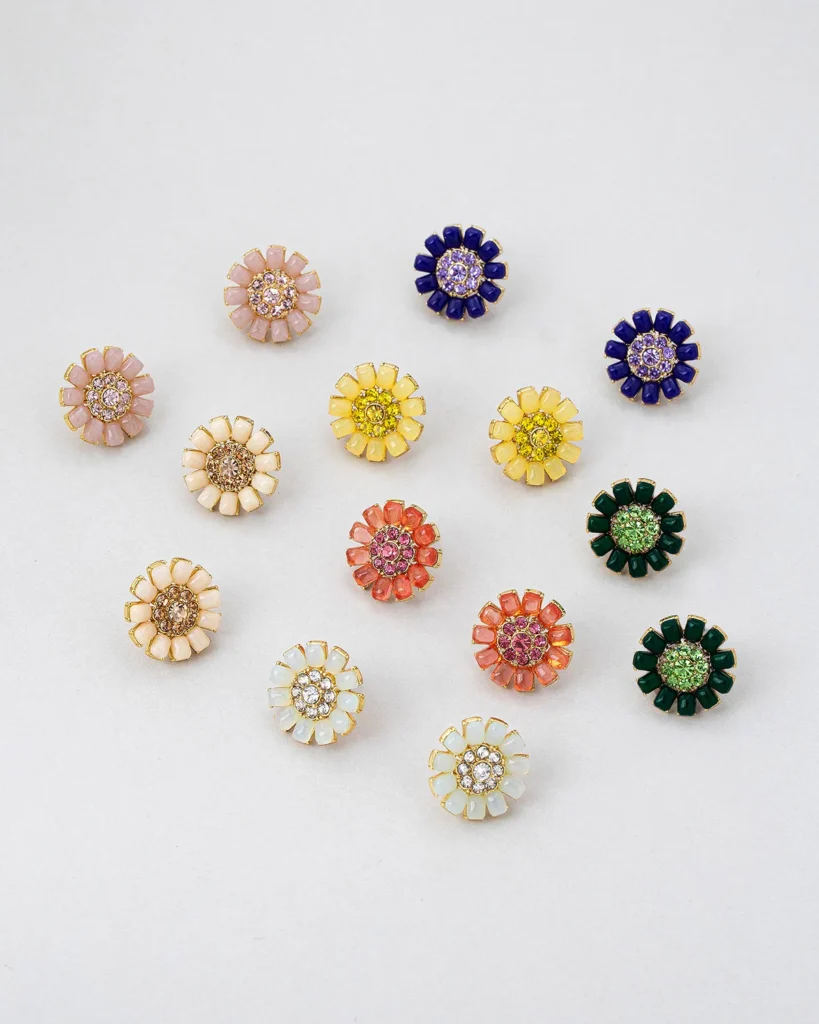
Resin and metal jewelry combines the visual flexibility of resin with the structure and finish of metal components. For B2B buyers, this combination creates more design possibilities, but it also introduces additional quality considerations. Material compatibility, component alignment, attachment points, surface finishing, weight, and color consistency should all be evaluated during sample development before a wholesale order is confirmed.
Why Combine Resin and Metal in Jewelry?
Resin can provide color, transparency, texture, and sculptural shapes, while metal components can add structure, contrast, and functional attachment points.
This combination is commonly useful for earrings, necklaces, rings, bangles, brooches, and other fashion jewelry designs.
For a wholesale buyer, mixed-material construction can also help create visual variety within a collection. A single resin shape can look substantially different when paired with different metal finishes, connectors, frames, or hardware.
The tradeoff is that the final product has more components to coordinate. A resin piece that looks correct on its own may not look balanced after the metal hardware is attached.
How Resin and Metal Affect Design
The two materials behave differently during manufacturing and finishing.
Resin can be molded into curved, oversized, transparent, translucent, or textured forms. Metal components can provide smaller structural details and attachment points.
This allows designers to combine:
- Large resin surfaces with small metal accents
- Transparent resin with contrasting metal hardware
- Sculptural resin shapes with metal frames
- Embedded resin designs with metal connectors
- Colored resin components with different metal finishes
The important sourcing question is whether the two materials work together as one finished product.
A buyer should evaluate the complete assembly rather than approving the resin component and metal component separately.
Weight Needs to Be Considered as a Whole
Mixed-material jewelry can have a different weight distribution from resin-only jewelry.
A large resin component may be relatively lightweight, while additional metal connectors, frames, posts, or decorative components increase the finished weight.
This is particularly relevant for statement earrings.
When reviewing a sample, measure the weight of the complete finished piece. Also consider where the weight is positioned. An earring with a heavy component concentrated far from the attachment point may feel different from a design with the same total weight distributed closer to the hardware.
For wholesale production, finished weight should be treated as a sample specification rather than estimated only from the appearance of the product.
Hardware Selection Affects Both Appearance and Quality
Metal hardware is part of the visual design.
The size, shape, material, and finish of a component can change the overall character of the jewelry. Copper and zinc alloy components can be incorporated into resin jewelry depending on the product design and required construction.
For buyers, hardware selection should be discussed during sampling.
Check:
- Component dimensions
- Metal finish
- Color relationship with the resin
- Attachment method
- Alignment
- Connection strength
- Overall proportion
A small connector that is slightly misaligned may be barely noticeable on a small accessory but much more obvious on a large resin statement piece.
Attachment Points Require Careful Inspection
The connection between resin and metal is one of the most important areas to inspect.
Depending on the design, metal hardware may connect to, sit against, or be incorporated into the resin component. The attachment needs to be visually clean and structurally appropriate for the intended product.
During sample approval, examine the connection from different angles.
Look for:
- Uneven positioning
- Excess material around the connection
- Visible gaps
- Misaligned components
- Rough resin edges
- Movement that is not intended by the design
The attachment point should also be considered when designing the mold. Changing the shape of the resin after sampling may affect how the hardware fits.
Color Matching Becomes More Complex
Mixed-material jewelry involves at least two visual material systems.
A custom resin color may need to work with gold-tone, silver-tone, or other metal finishes. Transparent or translucent resin can make this relationship even more noticeable because the metal may remain visible through or around the resin.
For private label collections, buyers should approve the complete assembled sample under normal lighting.
Do not evaluate the resin color alone and assume the finished combination will look identical.
Haishaer Jewelry can develop custom resin colors as well as transparent and translucent effects, while offering copper and zinc alloy components and hardware selection as part of its manufacturing capabilities.
Surface Finishing Is More Visible With Mixed Materials
Resin and metal have different surface characteristics.
A polished resin component paired with a heavily textured or poorly aligned metal component can create an inconsistent appearance.
Likewise, a transparent resin design can make imperfections around the metal attachment more visible.
Quality inspection should therefore consider the transition between materials.
Check whether:
- Resin surfaces are properly polished
- Edges are smooth
- Metal components have a consistent finish
- Components are correctly positioned
- The transition between resin and metal looks intentional
- There are visible scratches or manufacturing marks
For a wholesale buyer, this transition is part of the finished product—not merely a secondary detail.
Sampling Should Test the Complete Construction
A mixed-material design should be sampled as a finished assembly.
A useful sample review covers four areas:
| Area | Buyer Check |
| Resin | Color, clarity, shape, thickness, texture, surface |
| Metal | Material, finish, dimensions, color |
| Assembly | Alignment, attachment, proportions, connection |
| Finished product | Weight, appearance, consistency, packaging fit |
This approach helps identify problems before they become bulk-production issues.
For example, if a resin pendant looks correct but the selected connector makes the finished necklace too heavy or visually unbalanced, it is better to identify that issue during sampling.
Customization and OEM/ODM Considerations
Mixed-material jewelry is particularly suited to OEM and ODM development because the resin and hardware can both be adapted to a specific design.
However, buyers should distinguish between modifying an existing product and developing a new construction.
An existing resin shape with a different color may require relatively limited customization. A completely new shape combined with custom hardware can involve additional development work.
When requesting a quotation, provide the manufacturer with:
- Product drawings or reference images
- Resin dimensions
- Desired resin color
- Transparency requirements
- Metal component requirements
- Hardware finish
- Assembly expectations
- Target quantity
- Packaging requirements
This gives the manufacturer a clearer understanding of the project before sampling begins.
Quality Control for Resin and Metal Jewelry
Mixed-material products should be inspected at both the component and assembly levels.
For resin, check color consistency, dimensions, shape, surface finish, transparency, embedded elements, and edge quality where applicable.
For metal components, check finish, alignment, attachment, and visible surface defects.
For the finished product, inspect overall proportions, weight, symmetry, and the transition between resin and metal.
Batch consistency is especially important for wholesale orders. Comparing multiple finished pieces can reveal variations that are not apparent when inspecting only one sample.
Haishaer Jewelry includes hand polishing and quality inspection in its manufacturing capabilities, supporting the finishing and inspection stages of resin jewelry production.
Packaging Mixed-Material Jewelry
Packaging should accommodate the complete product rather than only the resin component.
Metal hardware can create contact points that may scratch polished resin surfaces during transportation if products are allowed to move excessively inside the package.
For private label orders, packaging can include logo cards, gift boxes, barcode labels, and other customized packaging requirements.
Before approving the packaging, test the actual finished jewelry inside it. This allows buyers to check both product protection and retail presentation.
How to Select a Mixed-Material Resin Jewelry Manufacturer
When evaluating a supplier, look beyond the finished product photograph.
A manufacturer should be able to discuss resin development, metal component selection, hardware integration, polishing, sample approval, and quality inspection.
Haishaer Jewelry is an OEM and ODM resin jewelry manufacturer based in Qingdao, China. The company has more than 20 years of resin jewelry craftsmanship experience and a 1,100-square-meter factory.
Its capabilities include custom resin colors, transparent and translucent effects, embedded designs, resin textures, enamel coating, copper and zinc alloy components, hardware selection, hand polishing, quality inspection, and private label packaging.
Buyers can review the resin jewelry product range or contact Haishaer Jewelry through its OEM/ODM inquiry page when developing a mixed-material collection.
Building a Reliable Resin and Metal Collection
Mixed-material jewelry gives designers more freedom, but that freedom needs to be supported by precise product specifications.
For wholesale sourcing, start by defining the resin shape, color, thickness, and finish. Then specify the metal components, attachment method, finish, and overall weight requirements.
Approve the complete assembled sample before bulk production and use that sample as a reference for quality control.
The best sourcing process treats resin and metal as one finished product from the beginning. This makes it easier to identify problems with proportion, weight, attachment, color coordination, and finishing before they affect a larger production order.
If you are developing custom resin and metal jewelry for a wholesale or private label collection, share your design references and product specifications with Haishaer Jewelry to discuss sample development and manufacturing requirements.
Buyer Questions
1. Can resin and metal be customized together in one jewelry design?
Yes. OEM and ODM development can combine custom resin shapes, colors, transparency, textures, and embedded details with selected metal components and hardware.
2. What should I inspect at the resin-to-metal connection?
Check alignment, attachment quality, visible gaps, rough resin edges, excess material, and whether the connection looks clean from multiple viewing angles.
3. Should the resin and metal components be sampled separately?
For initial development they may be evaluated individually, but the final approval should be based on the complete assembled jewelry. Weight, proportion, alignment, and color relationships can only be properly judged in the finished product.