
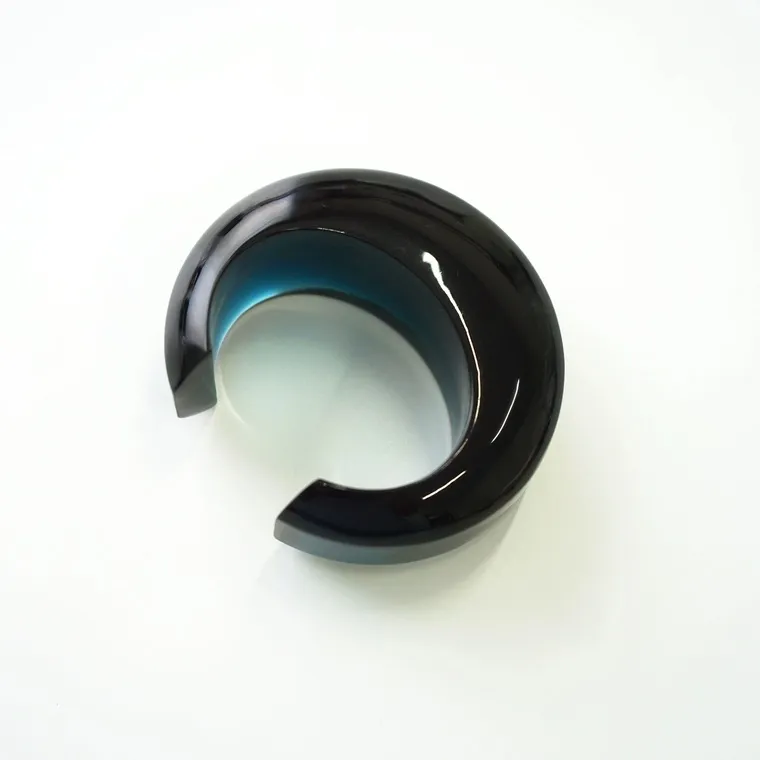
For B2B resin jewelry buyers, MOQ—or minimum order quantity—is rarely just one fixed number. A supplier may have different quantity requirements for samples, custom colors, packaging, and bulk production. Understanding what each MOQ applies to can help buyers prepare a more accurate RFQ, control inventory risk, and avoid unexpected production costs.
For resin jewelry, MOQ can be affected by the product design, resin color, hardware, finishing process, packaging method, and whether the order uses an existing design or requires new development. The right question is not simply “What is your MOQ?” but “What does your MOQ apply to?”
What Does MOQ Mean in Resin Jewelry Manufacturing?
MOQ is the minimum quantity a manufacturer is willing to produce for a specific order or production setup.
For resin jewelry, this may apply at several levels:
- Per design or SKU
- Per resin color
- Per size or variation
- Per hardware combination
- Per packaging configuration
- Per production order
These distinctions matter because a buyer might want 500 pieces across five colors, while a factory may calculate the production requirement separately for each color or design.
For example, an order containing one resin earring design in several custom colors may require different production arrangements from an order using one standard color across the same total quantity.
Before placing an order, ask the supplier to clarify exactly how the MOQ is calculated.
How Are Samples Different From Bulk MOQ?
Samples are normally handled differently from bulk production.
A buyer may need a pre-production sample to check:
- Resin color
- Shape and dimensions
- Transparency or translucency
- Surface finish
- Hardware
- Logo placement
- Overall appearance
A sample allows the buyer and manufacturer to identify design problems before committing to larger production.
For custom resin jewelry, sampling can be especially useful when the buyer has supplied artwork, color references, or a new product concept. A production sample can also reveal details that are difficult to evaluate from drawings alone, such as how a translucent resin looks under different lighting.
The sample quantity should therefore be discussed separately from the bulk MOQ. Buyers should also confirm whether sample costs, mold or development charges, and later bulk-order pricing are calculated separately.
Does Custom Resin Color Affect MOQ?
Custom color can have a direct effect on production planning.
Resin jewelry manufacturers may work with standard colors or develop a custom color based on the buyer’s requirements. Custom color matching can involve additional preparation and approval before bulk production begins.
If a buyer orders several colors in relatively small quantities, the factory may need to manage each color as a separate production requirement.
This is why buyers should provide a clear color plan during quotation. Instead of saying:
“We need 1,000 pieces in five colors.”
provide the expected quantity for each color.
For example:
| Order Detail | Example |
| Total quantity | 1,000 pcs |
| Color A | 300 pcs |
| Color B | 250 pcs |
| Color C | 200 pcs |
| Color D | 150 pcs |
| Color E | 100 pcs |
The actual MOQ will depend on the manufacturer’s production process and quotation, but this breakdown gives the factory a much clearer basis for evaluation.
How Does Packaging Affect MOQ?
Packaging can also create a separate production consideration.
Standard packaging and private label packaging are not necessarily handled the same way. A buyer may request:
- Logo cards
- Gift boxes
- Barcode labels
- Branded inserts
- Individual packaging
- Custom packaging materials
When packaging is customized, buyers should ask whether the packaging MOQ is different from the jewelry MOQ.
For example, the jewelry itself might be produced in several designs, while custom printed cards require a separate minimum quantity. If packaging is ordered in advance, excess packaging inventory can also become a cost consideration.
For private label projects, confirm these details before approving the final order:
- Packaging MOQ
- Packaging unit cost
- Artwork requirements
- Printing method
- Whether packaging is supplied by the buyer or manufacturer
- How unused packaging is handled
This helps prevent a situation where the jewelry quantity meets the production requirement but the selected packaging does not.
Bulk Orders: Why MOQ Should Be Discussed With the Whole Product Specification
A bulk order should be evaluated as a complete production specification rather than only a quantity.
For resin jewelry, the manufacturer may need to consider:
- Product design
- Resin material
- Color
- Transparency
- Embedded elements
- Surface texture
- Metal components
- Hardware
- Finishing
- Quality requirements
- Packaging
- Labeling
Haishaer Jewelry is an OEM and ODM resin jewelry manufacturer based in Qingdao, China. Its manufacturing capabilities include custom resin colors, transparent and translucent effects, embedded designs, resin textures, enamel coating, copper and zinc alloy components, hardware selection, hand polishing, quality inspection, and private label packaging.
For buyers developing multiple products, reviewing the Haishaer Jewelry product range can also help when preparing an initial sourcing brief.
MOQ and Multiple SKUs: What Should Buyers Ask?
A common sourcing mistake is to treat total order quantity as the only MOQ consideration.
Suppose a buyer wants 1,000 pieces but has 10 different designs. The factory may not treat this in exactly the same way as producing 1,000 pieces of one design.
The buyer should ask:
- Is MOQ calculated per design?
- Can different colors be combined?
- Can different SKUs share the same production setup?
- Does an existing mold have a different requirement from a new mold?
- Are packaging quantities calculated separately?
- Can sample approval cover multiple color variations?
These questions are more useful than asking for a single general MOQ number because they reveal how the supplier structures production.
How to Reduce MOQ Risk Without Sacrificing Product Development
Buyers with uncertain demand do not necessarily need to eliminate customization. Instead, they can structure the project more carefully.
One approach is to begin with a limited number of designs and colors, validate the samples, and then expand the range after the initial production has been evaluated.
Another option is to use existing product structures where appropriate and focus customization on resin color, finishing, hardware, or packaging.
For example, if a buyer is developing a private label collection, it may be more practical to finalize a few core designs first rather than simultaneously introducing many new shapes, colors, and packaging configurations.
The goal is to align product variety with realistic production quantities.
What Should Be Included in an MOQ Request?
A clear RFQ gives the manufacturer enough information to determine whether the requested quantities are practical.
Include:
- Product type
- Reference images or drawings
- Approximate dimensions
- Estimated quantity per SKU
- Desired resin colors
- Customization requirements
- Hardware requirements
- Packaging requirements
- Target market
- Sample requirements
- Expected order structure
For example, instead of asking, “What is your MOQ for resin earrings?”, a buyer can provide the number of designs, estimated quantity per design, color requirements, and packaging expectations.
That usually leads to a much more useful quotation discussion.
MOQ Should Be Evaluated Alongside Quality and Production Capability
A low quoted MOQ is not automatically the right choice for every sourcing project.
Buyers should also evaluate whether the manufacturer can consistently reproduce resin colors, maintain surface quality, handle hardware assembly, perform quality inspections, and support the required packaging format.
For custom resin jewelry, production consistency can matter as much as the initial order quantity. A supplier that understands the relationship between design, resin formulation, finishing, hardware, and packaging can help buyers identify production issues earlier.
For buyers comparing suppliers, Haishaer Jewelry’s manufacturing background provides an overview of its OEM and ODM capabilities and factory experience.
The best MOQ discussion is therefore a practical production discussion: what quantity is required, for which design, in which colors, with what packaging, and under what production conditions?
If you are developing a resin jewelry collection, you can send your designs, estimated quantities, color requirements, and packaging specifications to Haishaer Jewelry for a sourcing discussion.
Buyer Questions
1. Does MOQ apply separately to each resin color?
It can, particularly when custom colors require separate production preparation. Ask the manufacturer to confirm whether MOQ is calculated per color, design, SKU, or total order.
2. Should I order samples before confirming a bulk quantity?
For customized resin jewelry, sampling is useful for checking color, dimensions, finishing, hardware, and overall appearance before bulk production. The sample arrangement should be confirmed with the manufacturer before ordering.
3. Can private label packaging have a different MOQ from the jewelry?
Yes, packaging can have its own production requirements. Confirm the packaging quantity, printing requirements, and whether unused packaging can be stored or reused for future orders.